Direct answer
Anduril is the first large defense company built as a vertically integrated, software-defined product firm rather than as a cost-plus prime. It spends its own money to design the system, owns the AI command layer (Lattice), owns much of the hardware that layer runs on, and sells the result as commercial off-the-shelf kit. The customer buys a product. It does not fund a decade of development on a cost-plus contract.
That is a different industry from Tesla or BYD, and a different founder group from SpaceX. The method is the same: own the layers where a supplier’s margin and a supplier’s lead time both hurt you, put the model next to the machine, and be your own first customer.
2026 is when the method stopped being a pitch. In March the U.S. Army opened a 10-year, $20 billion-ceiling enterprise vehicle around Lattice. In May Anduril raised a $5 billion Series H at a $61 billion valuation on $2.2 billion of 2025 revenue. In June the Army named Anduril lead for the common data baseline of Next Generation Command and Control (NGC2). Fury, its collaborative combat aircraft, moved from first flight (October 2025) into production at Arsenal-1.
The $20 billion figure is a ceiling on a contract vehicle, not booked sales. Read it that way or the article is wrong.
xvertical does not work for Anduril. Anduril is not a client. The company is here only as a case a reader can check.
What vertical integration means at Anduril
In cars, vertical integration is a bill of materials: cells, motors, inverters. In defense it is a different stack.
Legacy primes are hardware-defined and software-enabled. The platform is the product. Software is written to the platform, slowly, under a cost-plus contract, after the metal is frozen.
Anduril inverted that. Palmer Luckey’s rule, quoted across the company’s own material: solve in hardware only what must be solved in hardware. Everything else, solve in software, where an update is free. Trae Stephens has framed the same split as software-defined, hardware-enabled.
The owned layers:
- Lattice, the AI operating system. It fuses sensors, classifies threats, and tasks effectors. It is hardware-agnostic enough to run on Anduril kit and on other people’s.
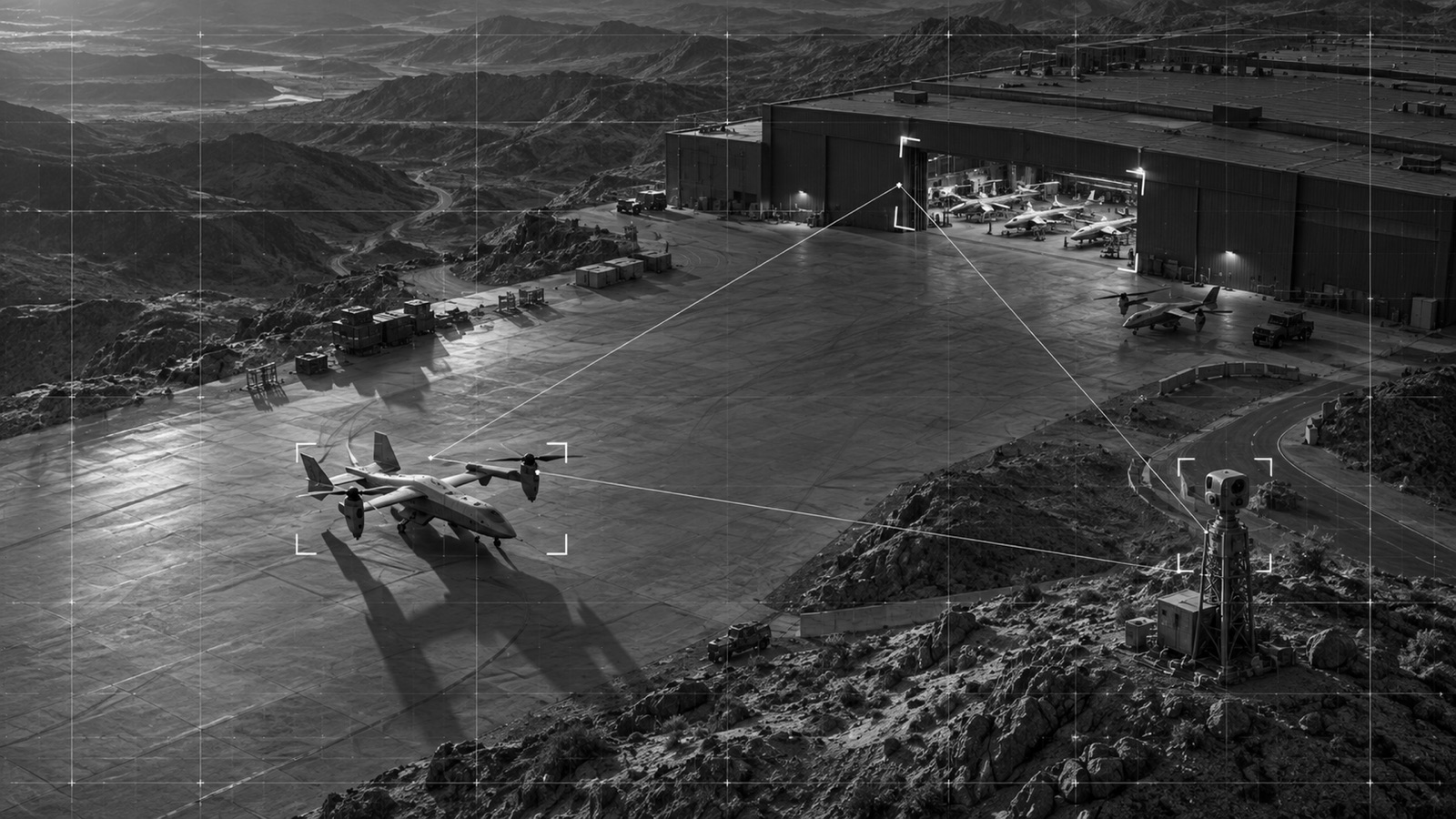
- The vehicles and effectors: Fury, Roadrunner, Barracuda, Ghost, Anvil, and undersea vehicles. Built so Lattice has something to command.
- Edge compute and sensors: ruggedized nodes (Klas acquisition), cooled infrared (AIRS acquisition), and tactical edge computers in the NGC2 kit.
- Propulsion: a Mississippi solid-rocket-motor plant, aimed at becoming a third U.S. tactical-motor source next to Northrop and L3Harris/Aerojet.
- The factory: Arsenal-1 in Ohio plus Arsenal OS, a software layer over design and production, so more than one product can run on the same commercial tooling.
- The balance sheet: products funded on internal capital, then offered as commercial off-the-shelf kit. The government is a customer, not a development bank.
That last point is the integration most people miss. Cost-plus is a form of dis-integration: the customer owns the requirement, the contractor owns the hours, and nobody owns the iteration speed. Paying yourself to build the product, then selling the product, puts requirement, design, factory, and software on one clock.
Luckey has said Lattice connects to roughly 700 partner companies and more than 100 existing Department of Defense platforms, and that some government customers have integrated without talking to Anduril. That is the opposite of a closed system. Anduril owns the spine. It does not try to own every rib.
The numbers that matter
There is no UBS-style 75% teardown of a fighter drone. Cite what is public and label the rest.
| Claim | Figure | Source | Date |
|---|---|---|---|
| Founded | 2017, Costa Mesa | Company | — |
| 2025 revenue | $2.2 billion (~2× 2024) | Company / Series H note | May 2026 |
| 2026 revenue target (unconfirmed as audited) | ~$4.3 billion | Investor reporting | 2026 |
| Series H | $5 billion at $61 billion post-money | Company, Thrive / a16z | 13 May 2026 |
| Series G | $2.5 billion at $30.5 billion | Company | June 2025 |
| R&D as share of revenue (2025) | >60% vs single digits at primes | Contrary Research | 2026 |
| Army Lattice enterprise vehicle | Up to $20 billion over 10 years, firm-fixed-price ceiling | Army / Breaking Defense | March 2026 |
| First task order on that vehicle | $87 million, counter-UAS C2 | Breaking Defense | March 2026 |
| NGC2 common data baseline lead | Lattice + Palantir Foundry + Raft | Army / Anduril | 22 June 2026 |
| Ivy Sting 1 | 26 live-fire missions; sensor-to-shooter < 1 minute | Anduril | Sep 2025 |
| Ivy Mass | 160+ tactical edge computers, 2,500+ devices, 40 apps, division scale | Anduril | May 2026 |
| Fury first flight | October 2025 | Company | 2025 |
| Fury production start, Arsenal-1 | March 2026 (plant ~4 months early) | Company / reporting | 2026 |
| CCA Increment 1 buy | 150 aircraft split with General Atomics | USAF | 2026 |
| CCA fleet target | ≥500 aircraft in service by 2032 | USAF, Sep 2026 | 2026 |
| Target unit cost (USAF ask) | ~$20 million average | Reporting | 2026 |
| Barracuda-500M floor order | Minimum 3,000 missiles | Reporting, May 2026 | 2026 |
| IVAS / soldier headset | Microsoft $22 billion headline is dead; Anduril holds a ~$159 million SBMC prototype | DefenseScoop / reporting | 2025–26 |
| Headcount | ~7,000; nearly doubled in a year | Company | 2026 |
How to read the table. The $20 billion line is an ordering rail. Matthew Steckman, Anduril’s president, said it in March: there is no money attached up front; any federal buyer can purchase commercially made products against it. It folds more than 120 prior contracts into one mechanism. That is integration of buying, not a $20 billion cheque.
The $22 billion IVAS number should not appear in a 2026 article as live Anduril revenue. The Army zeroed IVAS 1.2 procurement and re-scoped the effort. Anduril’s live work is a prototype cycle.
Fury’s airframe win is not a Lattice-for-Mission-Autonomy win. The Air Force is buying the jet and the autonomy software on separate contracts. As of mid-2026 Anduril sat in a six-vendor autonomy pool with General Atomics, Lockheed, Northrop, Collins, and Shield AI.
Why this is vertical integration, not another defense software product
Three tests.
-
The software is useless without the hardware, and the hardware is mute without the software. Lattice is the product Anduril will not rent out as a thin wrapper on someone else’s stack and call it a day. Roadrunner, Fury, Ghost, and the edge nodes exist so the model has a body. That is closer to Tesla’s vehicle-plus-driver software than to a Palantir-only deployment, and Anduril still partners with Palantir on NGC2, which is the point. Own the layer you must control. Federate the rest.
-
The factory is part of the product. Arsenal-1 is not a job-shop that builds to a drawing the government already paid for. Anduril describes Arsenal as a software-defined manufacturing platform: common commercial tooling, Arsenal OS across design and production, more than one vehicle family on the same line. Fury production starting four months early is the claim that has to keep being true. If the factory is late, the software story is a demo.
-
The contract shape matches the architecture. Cost-plus pays for hours. Firm-fixed-price commercial kit pays for a working system. A 10-year enterprise vehicle that any federal buyer can draw on is how you stop re-competing the same command software for every brigade. Integration of the commercial motion into the government’s buying motion is as important as integration of the seeker into the airframe.
Contrary’s 2026 breakdown put Anduril’s research and development above 60% of revenue. Primes sit on single digits. That ratio is what a product company looks like before the factory is fully loaded. It is also why 2026 guidance that implies large operating losses on Arsenal-1 scale-up should be treated as the cost of the strategy, not as a surprise.
The 2026 proof points
Lattice becomes Army plumbing. NGC2 has four layers: transport, data, integration, applications. On 22 June 2026 the Army gave Anduril the data-layer baseline: Lattice as the integration spine, Palantir Foundry for the edge-to-cloud mesh, Raft for registries and federation. Lockheed keeps the full-stack lead at 25th Infantry Division. Anduril keeps 4th Infantry Division and the common layer that both will have to speak.
The operational path that produced that decision:
- Ivy Sting 1 (September 2025). 4th Infantry Division fired 26 live missions with M777s through the Artillery Execution Suite on Lattice. Sensor-to-shooter dropped below a minute. The division adopted it as standard digital fire control.
- Ivy Mass (May 2026). The whole division on NGC2 at Fort Carson and Piñon Canyon: 160-plus tactical edge computers, 2,500-plus end-user devices, 40 applications, under cyber and electromagnetic attack conditions.
That is the closed loop. The software is not a briefing. It is how a division already shoots.
Fury leaves the hangar. First flight October 2025. Production at Arsenal-1 from March 2026. In September 2026 the Air Force named the type FQ-44A Fury and restated a path to at least 500 collaborative combat aircraft in service by 2032, with Increment 1 at 150 airframes shared with General Atomics’ FQ-42A Vengeance. Target average cost asked of both vendors: about $20 million. Lattice for Mission Autonomy is a separate fight.
The buying rail exists. The March vehicle is how a startup becomes a catalogue the Department of Defense can order from without inventing a new request each time. Counter-drone was the first task order because that is the mission special operations and the Army already pay for in volume. Roadrunner, the reusable interceptor, had already been the largest single hardware buy in the earlier counter-UAS run.
International and munitions. First foreign program of record with the Royal Australian Navy. Dutch counter-drone award, May 2026, with initial operating capability claimed inside a month of signing. A floor order of 3,000 Barracuda-500M cruise missiles just before Series H. Mississippi motors aimed at 6,000 tactical units a year by end-2026. These are not software features. They are the physical inventory the software is supposed to aim.
What Anduril still does not own
It does not own the U.S. government. A $20 billion ceiling is not $20 billion of revenue. House authorizers in 2026 drafted cuts to NGC2. Programs of record slip. IVAS already did.
It does not own collaborative-combat-aircraft autonomy. Winning the airframe and winning the brain are separate competitions. Shield AI’s Hivemind has been in the Fury conversation. Treat “Anduril will run the loyal wingman fleet” as a claim, not a fact.
It does not own every sensor and every plant. Lattice’s value is that other people’s systems can plug in. That is a owned spine with other firms around it, closer to Apple plus a foundry than to BYD’s 75% of one car. The AIRS and Klas deals show where Anduril does pull a layer in-house: cooled infrared and rugged edge boxes, because those were bottlenecks for Lattice at the tactical edge.
It does not yet have a prime’s profit and loss. $2.2 billion of revenue against a $61 billion mark is a product-company multiple, not a Lockheed multiple. Reporting of further talks near $100 billion in mid-2026 had not closed as of September. An initial public offering is discussed, not filed. Arsenal-1 has to turn research spending into unit cost, or the multiple compresses.
It is still a weapons company. The vertical-integration story is an operating-model story. It does not require inflating what the hardware does. Interceptors, cruise missiles, and unmanned combat aircraft are the products. Write them as products.
Is this the same idea as BYD and Tesla?
Same test, different starting point.
| Test | Tesla / BYD | Anduril |
|---|---|---|
| Expensive layer is physical | Cell, inverter, driving chip | Airframe, motor, seeker, edge node |
| Volume amortizes the plant | Millions of cars | Thousands of munitions and airframes, if Arsenal works |
| Model co-designed with the machine | Driver software / Xuanji on the vehicle | Lattice on the sensor-to-shooter loop |
| First customer is yourself | Factories, fleet | Own test ranges, then 4th Infantry Division |
| What you refuse to rent | The learning loop | The command spine and the iteration clock |
What does not transfer: Anduril will never show a 75% bill of materials on a public teardown. Defense supply chains are classified, dual-sourced, and political. The honest metric is not “percent in-house.” It is “which layer, if late or rented, stops the loop.” For Anduril that layer is Lattice plus the factory that can print the bodies Lattice commands.
Programs that bolt a chatbot onto a cost-plus prime do not pass this test. Neither does a software startup that uses the same word for a different business. Different word, different firm.
What operators should copy, and what they should not
Copy:
- Fund the first system yourself. Then sell the system. Do not sell hours.
- Put one operating system under every machine you ship. Let third parties plug in. Own the spine.
- Change the contract shape to match the architecture. If you sell a product, stop signing cost-plus development.
- Measure the loop in operational units (minutes from sensor to shooter, divisions on the network), not in model benchmarks.
Do not copy:
- “We are the Anduril of X” without a factory and a spine. Lattice without Arsenal is a demo. Arsenal without Lattice is a job shop.
- A $20 billion headline. Use ceilings as ceilings.
- Pulling every supplier in-house. Anduril’s 700-partner claim is a feature. BYD’s 75% is a different industry’s math.
Key takeaways
- Anduril is a product company in a cost-plus industry: own Lattice, own enough hardware and factory to run it, sell a finished product.
- 2026 evidence: Army $20 billion-ceiling vehicle, NGC2 data-layer lead, Fury in production, $2.2 billion of 2025 revenue, $61 billion Series H.
- Ivy Sting and Ivy Mass are the citations for “the software already shoots,” not the valuation.
- Fury airframe is not Fury autonomy. The $22 billion IVAS headline is not current Anduril work.
- Same transfer test as BYD: physical bottleneck, volume, co-design, you are the first customer. Different industry, same filter.
Sources
- Anduril, “U.S. Army Selects Anduril to Lead Common Data Baseline” (NGC2), 22 June 2026. anduril.com
- Anduril, “Anduril Announces $5B Series H Raise,” 13 May 2026. anduril.com
- Breaking Defense, Army $20 billion contract vehicle and $87 million first task order, March 2026; NGC2 data-layer award, June 2026.
- DefenseScoop, NGC2 common data layer, 22 June 2026.
- Contrary Research, Anduril business breakdown (software-defined and hardware-enabled, research intensity), 2026.
- The Merge, Series H mechanics, Barracuda floor order, Fury production timing, June 2026.
- Venture Atlas and contemporaneous 2026 reporting: collaborative-combat-aircraft naming, autonomy split, IVAS re-scope, revenue figures.
The $20 billion figure is a ceiling. The $22 billion IVAS figure is a retired headline. Quote operational counts (missions, devices, divisions), not unsupported compute claims.
Questions this essay answers
What is Anduril's vertical integration strategy?
Anduril designs and funds products on its own capital, owns the AI command layer (Lattice) and a large share of the hardware and manufacturing that layer needs, and sells the result as commercial kit. It is software-defined and hardware-enabled, the reverse of a classic prime.
What is Anduril Lattice?
Lattice is Anduril's AI operating system for command and control. It fuses sensors, classifies threats, and tasks effectors across air, land, and sea. The Army chose it as the common data baseline for NGC2 in June 2026, paired with Palantir Foundry and Raft.
Did Anduril win a $20 billion Army contract?
It won a 10-year enterprise contract vehicle with a $20 billion ceiling in March 2026. That is an ordering guide, not $20 billion of obligated revenue. The first task order was an $87 million counter-drone award. NGC2 work sits on the same vehicle.
What is Fury?
FQ-44A Fury is Anduril's collaborative combat aircraft, selected with General Atomics for U.S. Air Force Increment 1. First flight was October 2025. Production at Arsenal-1 began March 2026. Increment 1 is 150 aircraft shared between the two vendors; the service has talked about 500 CCAs in service by 2032. Mission-autonomy software is a separate competition.
How is Anduril different from Lockheed or RTX?
Primes are paid to develop to a specification, usually cost-plus, and treat software as something that follows the airframe. Anduril pays itself to build a product, iterates the software continuously, and uses firm-fixed-price COTS vehicles. R&D intensity in 2025 was reported above 60% of revenue, versus single digits at the primes.
How is Anduril different from Palantir?
Palantir sells the data and decision layer into the customer's existing machines. Anduril sells the decision layer and many of the machines. On NGC2 they are partners, Lattice plus Foundry. That split is the clean version of owning the spine and federating the rest.
Is Anduril an AI-native company?
Yes, in the industrial sense. The product is a closed loop of sensors, model, and effectors, updated as software and manufactured as hardware. It is not an AI-native company in the sense of a wrapper around a frontier model.
Is vertical integration a good idea for defense companies?
It is a good idea where the constraint is iteration speed and the government will buy a finished product. It is a bad idea where the customer insists on owning the requirement line by line and paying for hours. Anduril's bet is that enough of the Department of Defense has moved to the first column.