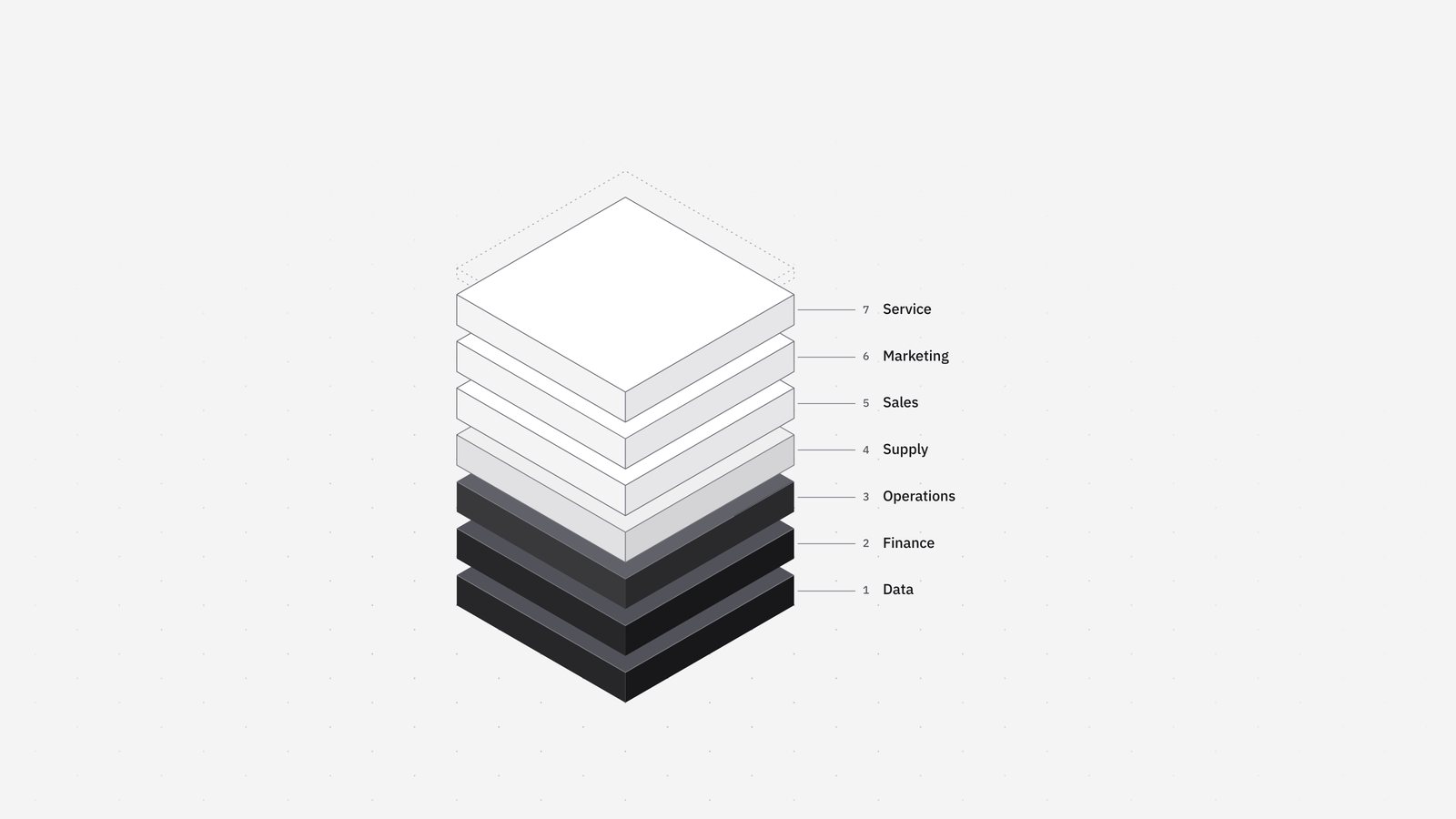
A finished product is a chain of stages. Someone designs it. Someone makes the parts. Someone puts it together. Someone tests it. In most companies, several of those stages are purchases. Another firm does the work, sends an invoice, and keeps the know-how.
Vertical integration is the decision to stop buying one of those stages and to run it yourself.
SpaceX is a useful public example because the company has described this choice, and reporters have been inside the factory. xvertical does not work for SpaceX. SpaceX is not a client. The company is here only as a case a new reader can check.
What the choice actually is
Picture a firm that sells a machine. It can buy the motor from a specialist, or it can hire motor engineers and build the motor on its own floor. The machine at the end can look the same. The firm is not the same. In the second version, the motor is part of the company. The payroll, the mistakes, and the next improvement all sit inside.
That is vertical integration. The word “vertical” means up and down the chain, from raw material toward the customer. The word “integration” means those stages now belong to one organization.
The opposite is easy to picture. Each stage stays in a different firm. You pay for the stage. You wait for that firm’s calendar. You do not employ the people who know how the stage really works.
Owning a stage is not a moral position. It is a bet that your own team will run that stage better than the firm you used to pay.
A rocket makes the chain easy to see
Before a rocket leaves the ground, someone has to design the engine, build the fuel tanks, make the electronics that steer it, write the software that flies it, test the engine on the ground, and operate the launch. Any one of those can be a contract with another company.
For a long time, that was the normal shape of the aerospace industry. A lead firm assembled work that many suppliers had already priced and scheduled. Each supplier had other customers. Your rocket was one job in their queue.
SpaceX did not start with this plan
Aviation Week reported in July 2024 that vertical integration was not SpaceX’s original plan. In 2001 and 2002, Elon Musk tried to buy Russian rockets. That purchase did not happen. He was also unhappy with the prices quoted by U.S. suppliers. SpaceX then hired engineers and designed its own early rocket, Falcon 1, including the Merlin engine, the rocket body, and the flight computers.
The pattern was practical. The stages SpaceX could not buy on acceptable terms became stages it learned to do.
What SpaceX brought inside
SpaceX says this about its Hawthorne factory, on its own sites page:
“As a company, SpaceX is vertically integrated, building the vast majority of the vehicle on the Hawthorne campus, which remains one of the few facilities in the world where you can see an entire launch vehicle or spacecraft come together under one roof.”
The same page says the company is “making everything from rocket engines to human crewed spacecraft, advanced satellites, Starlink kits, data center and power infrastructure, advanced chips, and more.”
Its Falcon user’s guide of 9 May 2025 is more specific about the rocket. SpaceX writes that it “privately developed the Falcon family of launch vehicles.” The parts it names are “first and second stage engines, cryogenic tank structures, avionics, guidance and control software, and ground support equipment.” Avionics are the electronics that steer the rocket. Cryogenic tanks are the tanks that hold the super-cold fuel.
The same guide explains why the designers sit on the factory floor:
“SpaceX products are designed to require low-infrastructure facilities with little overhead, while vehicle design teams are co-located with production and quality assurance staff to tighten the critical feedback loop. The result is highly reliable and producible launch vehicles with quality embedded throughout the process.”
On 22 May 2018, CNBC’s Morgan Brennan reported from the Hawthorne factory after speaking with Gwynne Shotwell, then president and chief operating officer, and Andy Lambert, then vice president of production, about how the rockets are made.
Wired made a related count on 18 May 2012, early in the Falcon and Dragon years. It reported that “more than 80 percent of the Falcon rocket and Dragon spacecraft are built in-house,” from the engine’s combustion chamber to the capsule. That sentence describes those vehicles in 2012. It is not a current audit of every SpaceX product.
By 2024, Aviation Week described a wider set. SpaceX designs its rocket motors, laser communications, satellites, and spacesuits. It owns the Starbase launch site in Texas. It runs recovery ships and its own flight-control centers, and it was building an astronaut corps. The owned chain had grown past the rocket itself.
What SpaceX still buys
Owning the chain does not mean machining every washer.
Robert Pakalski, who worked at SpaceX and is now chief executive of Datum Source, told Aviation Week in that 2024 article:
“SpaceX is entirely vertically integrated as a subassembly integrator. But from the actual individual components that make up the rocket or spacecraft, the majority of that is outsourced versus vertically integrated.”
Many of those pieces are made by outside shops and then return to SpaceX to be put together. The company designs most of them instead of buying a catalog part.
Hold that distinction. Vertical integration, in this example, means SpaceX owns the design and the stages that decide the vehicle. It does not mean a factory with no suppliers. Raw material and a great many components still come from other firms.
What an organization gains
SpaceX’s own guide names the gains in operational language: simplicity, reliability, and cost, with quality “embedded throughout the process.”
Quality improves when the people who will live with a defect can stop the work. They do not have to write a complaint to another company’s queue.
Time improves when a change does not wait on someone else’s calendar. The guide says design teams sit with production and quality staff “to tighten the critical feedback loop.”
Cost can improve because you stop paying another firm’s price on that stage. You do not become cheap by declaration. You remove a layer of margin and delay, and you take on the cost of the people and the tools. If your team is worse at the stage than the specialist you fired, the layer you removed comes back as scrap and rework.
There is a fourth gain, and it shows up only if you fly, ship, or operate often enough to learn. Rob Meyerson, president of Blue Origin from 2003 to 2018, told Aviation Week:
“[SpaceX’s] ability to understand every piece and component in their system in detail is built on the fact that they design and build most of what’s in that rocket.”
He added that the company tests a lot, analyzes quickly, and flies often enough to put the lesson into the next vehicle. Pakalski, from inside the factory, said: “I never worked on one rocket my entire time at SpaceX that was the same rocket from the one that launched previously.”
When design, build, and use sit in one organization, a lesson does not have to cross a contract to become the next version.
What it costs
The owned stage has to be staffed, housed, and managed. The supplier’s late delivery becomes your late delivery. The supplier’s bad part becomes your bad part.
Brad King, chief executive of the propulsion firm Orbion, gave the caution in a SpaceNews report of 4 February 2025:
“Most vertical integrations are the result of being hurt by a supplier. So if you’re very good at doing it yourself, you can consider vertical [integration]. Or if there isn’t a viable supply chain, or you’ve been hurt, I think it goes vertical, but I don’t think it is a virtue in and of itself.”
If you are good at the stage, or if nobody can sell it to you, owning it can be rational. Owning it for the slogan is not.
SpaceX is an extreme public case. A smaller firm does not need a rocket factory to use the same test. List the stages you currently buy. Mark the ones that decide your cost, your speed, or your quality. Those are the candidates. Leave the rest outside until you can run them.
Sources
Each quote above is linked where it appears. This is the full list.
- SpaceX, sites: Hawthorne. The company’s own line that it is vertically integrated and builds the vast majority of the vehicle on that campus.
- SpaceX, Falcon User’s Guide, 9 May 2025 (PDF). The list of Falcon hardware SpaceX developed, and the line that design teams sit with production and quality staff.
- Morgan Brennan, CNBC, 22 May 2018. Report from the Hawthorne factory with Gwynne Shotwell and Andy Lambert.
- Jason Paur, Wired, 18 May 2012. The in-house share of Falcon and Dragon that year.
- Garrett Reim, Aviation Week, 5 July 2024. Why SpaceX started building its own rocket, plus Meyerson and Pakalski.
- Debra Werner, SpaceNews, 4 February 2025. Brad King on when the choice is rational.
Questions this essay answers
What is vertical integration?
It is the choice to own a stage of the work instead of buying that stage from another firm. The company hires the people, owns the tools, and is responsible for the result.
Did SpaceX make every part of its rockets?
No. SpaceX designs and builds most of the rocket and the spacecraft, including engines, tanks, flight electronics, and flight software. Many individual pieces are still made by outside shops and then assembled by SpaceX.
What does an organization gain by owning a stage?
On the stages it can actually run, it gains more control of quality, timing, and cost. A lesson from the work can change the next version without a contract in the middle. A stage it cannot run is cheaper to buy.